The current City Code of Ethics & Values is a public trust code: a set of behaviors that prescribe how city government ought to act to earn, build, or rebuild public trust.
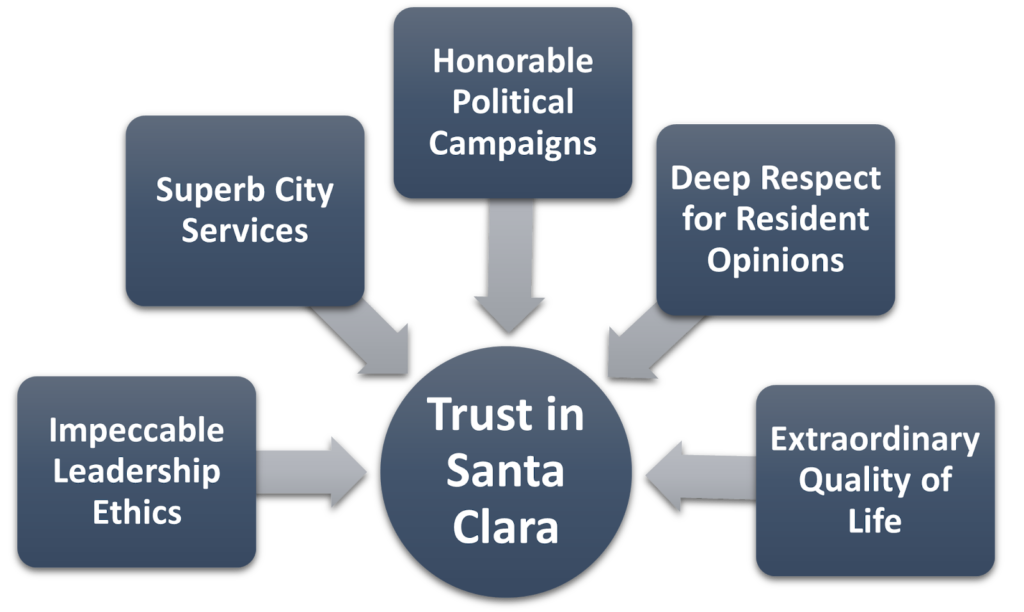
Research at the height of the ethics program in 2006-2008 repeatedly showed that trust in the City of Santa Clara rose or fall along with five other perceptions that the people of Santa Clara formed over time based on what they experienced, read, read about, or heard about.
The City defined public trust as the people’s confident reliance that their local government operates at all times–in public and in private–solely to advance the best interests of the people of Santa Clara, and never lets private, public, or special interests gain control, power, or sway over local decisions, especially if that power will harm the public.
The notion of “confident reliance” sometimes throws people, but it simply describes that extent to which people believe they can confidently rely on the City Council or City Staff showing up, ready to fulfill its multi-part duty to the public.
Trust in Santa Clara is directly related to:
- Elected, Appointed, Senior City Staff and staff in general practice impeccable leadership ethics, meeting the highest standards of professional public ethics
- City services are superb: high quality at reasonable cost, responsive, prompt, courteous
- Political campaigns are honorable: truthful and honest, fair, respectful of neighbors, their families, reswidents and voters, and the position sought, third parties follow campaign rules. See ethical campaign checklist.
- Decision-makers show deep respect for the public’s opinions; engagement is cultivated, meaningful input is built into especially public facing documents and policies
- Quality of life: the city reaches a baseline of satisfaction for public policy, laws and regulations, living, working, retiring, being entertained in the city; the political system reflects the real values of the public.
When public trust in local government collapses, here’s what typically happens:
IMMEDIATE EFFECTS:
Civic Micromanagement
- The public becomes over-involved, because they believe the Council and staff are not listening to them.
- Public monitors attend meetings and if they believe the Council is heading toward a decision not in the people’s best interest, monitors put out the word on social media, and 200 come over to the meeting in session.
- The public comments on everything, pulls items on the consent calendar, more members of the public get up and say the same things; meeting efficiency grinds to a halt.
Civic disengagement
- Voter turnout plummets
- Qualified candidates won’t run for office
- Volunteers stop serving on boards/commissions
- Public meetings become confrontational or empty
Compliance breakdown
- Residents ignore regulations they see as illegitimate
- Tax compliance decreases
- Permit applications drop (people work around or ignore the system)
- Community cooperation with city initiatives disappears
OPERATIONAL IMPACTS:
Paralysis and inefficiency
- Every decision faces suspicion and opposition
- Simple projects require extraordinary effort
- Staff morale deteriorates
- Talented employees leave for other cities
Financial consequences
- Bond measures fail repeatedly
- Economic development stalls (businesses avoid unstable governance)
- Litigation costs increase
- Credit ratings may suffer
VICIOUS CYCLES:
The trust death spiral
- Reduced engagement → decisions made without broad input
- Poor decisions → problems emerge
- Problems → officials become defensive, less transparent
- Defensiveness → trust drops further
Power vacuum
- Special interests fill the void left by disengaged residents
- Decisions favor those who show up (usually not representative)
- Corruption risk increases when no one’s watching
COMMUNITY DETERIORATION:
Social fabric frays
- Neighbors stop working together on shared problems
- “Every person for themselves” mentality
- Community pride disappears
- Property values can decline
Service quality drops
- City can’t implement needed improvements
- Infrastructure degrades
- Parks, libraries, programs suffer
- Residents who can afford it move away
SANTA CLARA SPECIFIC INDICATORS:
You’re already seeing several of these:
- 91% to 37% approval drop = massive civic disengagement warning
- “Small group of dissidents” rhetoric = officials dismissing engaged residents
- Reduced public comment = trust so low they’re limiting input further
- Civil Grand Jury criticism + no response = accountability breakdown
- Missing documentation = transparency collapse
THE RECOVERY CHALLENGE:
Why it’s hard to reverse:
- Takes years to build trust, moments to destroy it
- Cynicism becomes self-reinforcing (“nothing will change anyway”)
- Good people avoid toxic situations
- Each failed reform attempt deepens skepticism
What makes recovery possible:
- Clear acknowledgment of the problem (not denial)
- Systematic transparency and accountability measures
- New leadership willing to do the hard work
- Patient, persistent citizen engagement
- Measurable progress on concrete issues
THE OPPORTUNITY:
Santa Clara is at a critical inflection point. Your three simultaneous reform projects (Charter Review, Ethics Code, Ethics Commission) could reverse the spiral IF:
- Residents engage substantively (hence PEN)
- Officials recognize the crisis as real
- Reforms actually embed accountability (not just cosmetic changes)
- Progress is tracked and celebrated
Without intervention, you’re looking at:
- Continued decline in civic health
- Brain drain of talented residents and staff
- Stagnant or declining community vitality
- Potential state/county intervention if bad enough
- A generation to rebuild what was lost
With successful reform:
- Trust can rebuild in 2-3 years (faster than it eroded)
- Virtuous cycles replace vicious ones
- Santa Clara becomes a model again (like 2006-2008)
- Community capacity strengthens for future challenges
This is why your baseline survey matters so much – it documents the crisis objectively, making denial impossible. The 91% to 37% story is devastating and undeniable.
Want me to help you frame this for the PEN platform in a way that motivates action without inducing despair?