Welcome to Public Ethics Now (PEN). We are actively growing and are open for business as of January 14, 2026.
1. Our Mission
We champion ethical leadership, good governance, honorable political campaigns, and public trust in the City of Santa Clara.
PEN is an independent, nonpartisan, evidence-based ethics education and accountability site for Santa Clara residents, business owners, city workers, and public officials.
We celebrate ethical leadership and call out actions that damage public trust, using Santa Clara’s 2001 Code of Ethics & Values and 2008 Behavioral Standards as reference points.
We also provide a safe space for respectful dialogue and are building a community of practice—because complex ethics problems require shared experience and shared solutions.
b.) Why Santa Clara?
This site focuses on the City of Santa Clara because:
Deep Experience Dr. Tom Shanks, PEN's Founder, served as the City’s on-call ethics consultant (1998–2015) and, since 2022, has provided Santa Clara stakeholders with independent ethics analysis as a public service.
Unusual Governance + Stadium Ethics Gap Levi’s Stadium governance creates uncommon ethics risks: the City Council also serves as the Stadium Authority Board—yet the Stadium Authority has no ethics code and is excluded from Charter Review because of a technicality.
A Defining Civic Moment Santa Clara built a national ethics reputation—then dismantled it. Despite three negative Civil Grand Jury reports, the Council majority has continued to ignore ethical issues, treat ethics as a political weapon, and deny that the City has a growing public trust problem.
This year (2026), in addition to all the other special projects, the City has created a defining moment for the City and all of its stakeholders. conducting three major reviews: the City Charter, the 2001 Ethics Code, and the Grand Jury recommendation to establish an independent ethics commission.
No matter what the City decides about these projects, it will be a defining moment for the City and will impact the people for better or worse and for decades.
Our review of the current process and approach Unless the people intervene, stand up, and speak out, Santa Clara will wind up with a charter review that excludes ethics and the Stadium Authority, a compliance code that asks city officials to follow the minimum standards of the law, and either rejecting the ethics commission for the third time or designed it to fail.These are opportunities for real reform, better governance, sustainable decades, yet, as they are currently proceeding, no real reform will happen. The Council and Senior Staff are defining the tasks narrowly, working behind closed doors, replacing codes that should be built upon, restricting public input until after the major decisions have already been made,
Leadership Failures Documented Three Civil Grand Jury reports document ethics and governance failures. Yet visible “tone-from-the-top” ethics leadership remains limited or non-existent for the Council and among staff. City Manager Grogan has issued no city manager directives about staff ethics, building an ethical culture, or clarifications about the importance of ethics among City staff.
c.) The Santa Clara Ethics Story
1.) Then: A National Model (1998-2012)
Santa Clara was once a national model for ethical governance—defining ethics as “government at its best earning the people’s trust.”
Highlights included:
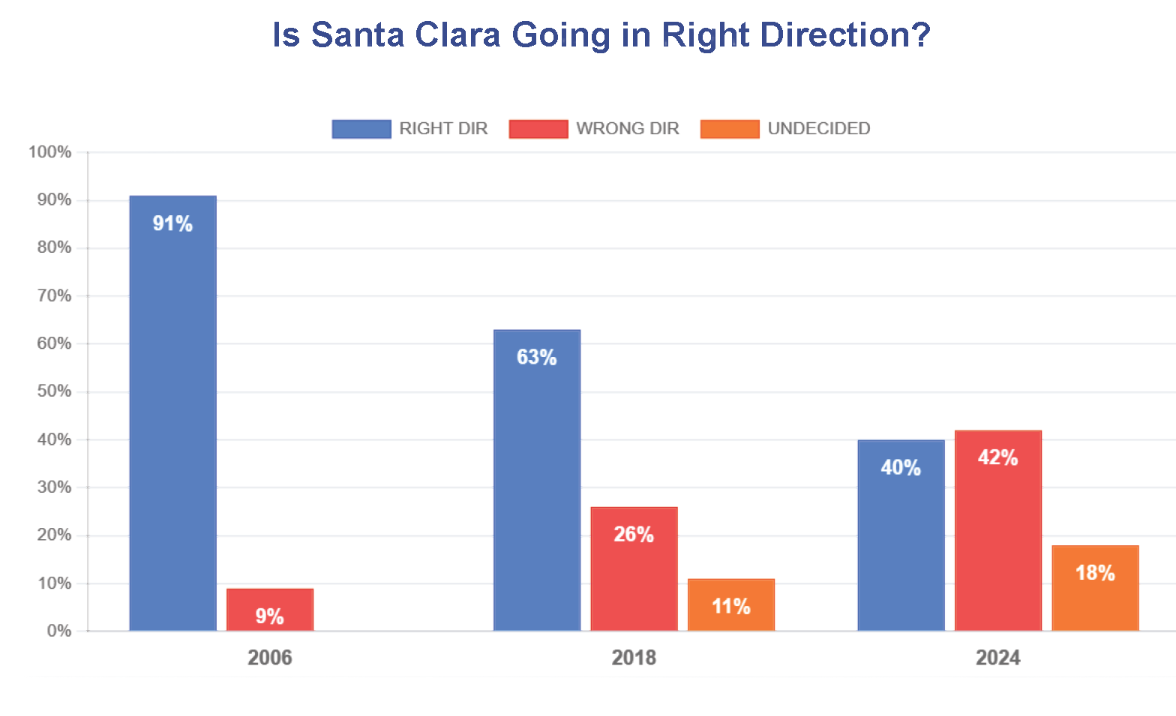
91% "going in right direction (2006)
UNESCO recognition for campaign ethics
Two Helen Putnam Awards (including the top prize, 2002)
A city studied nationwide as a best-practice example
Key lesson: Law is the floor—not the ceiling. Public trust requires integrity, transparency, accountability, and trustworthy leadership.
2. Now: A Reverse Role Model (2013-present)
Today, ethics is too often ignored, treated as optional or political—and critics are dismissed as enemies.
Results:
Only 40% believe the city is going in the right direction (a steep drop since 2006)
Three Civil Grand Jury reports documenting systemic breakdowns
$13M in independent expenditures reshaping council majorities
An ethics program “on life support,” with replacement efforts shifting toward compliance over integrity
3.) If Ethics and Law Were the Same, It Would Be Ethical For:
Deep-pocketed 49ers PACs to spend $13M since 2020 capturing five of seven seats on the Council and Stadium Authority Board
That majority to ignore the apparent conflict of interest and support virtually every decision favoring the team, growing the 49ers' estimated value from $1.4B to $8.6B
The City Manager to delay hiring an ethics consultant for seven months, then have them work behind closed doors for a year with no publilc review of ethics documents as Coumcil approved on July 11, 2013, and no public input
The City Attorney to shepherd a Charter Review that excludes the Stadium Authority, ignores ethics, and continues the city's slide toward what Gandhi called "Politics Without Principle"
All legal. None ethical.
4.) Who Decided to Replace the Ethics Code? We Don't Know.
The City has been quietly dismantling the ethics program since the 49ers came to town. Now the City is about to replace the Ethics Code with a legal-compliance, rather than an integrity-focused, code. This was not a decision made at an agendized meeting with the opportunity for public comment. It just happened.
These are the "defining moment" stories we are following. We submitted a Public Records Request on October 15 to see the contract with the ethics consultant and communications changing the review to a code replacement. Three months and five delays later, we still have not received those documents either the contract or the direction to replace the Code.
This is important. We know that the RFQ was for an ethics documents review. We imagine that's what the contract was written for. But during the year (!) after the city wrote the contract something changed. Who authorized it? Was the contract rewritten? Stay tuned.
STAY CONNECTED TO US
1. Sign Up for Email Updates
To receive notices about these and other important new stories, fill out this short form. Once subscribed to this list, you may send send Dr. Shanks questions, comments, and other feedback through our contact form.
Enter your real name and email above. After you hit submit, check your inbox for a verification email. Once you verify your email address, we'll let you know you've completed the signup process and we'll include a link to the Trustworthy Leaders Checklist—the seven behaviors Santa Clara residents said they expect from leaders they trust.
We will never share your data with anyone. Using the link in the top menu, please read our Privacy Policy.
Thank You, we'll be in touch soon.
2. Public Trust Partners
Want to work with others to improve ethics and public trust in Santa Clara?
Join with others who want to advance ethical leadership and rebuild public trust in the city. Become a charter member of the new Public Trust Partners community.
Public Trust Partners can:
Participate in protected forum discussions using your PEN name
Comment on articles throughout the site
Connect safely with other Santa Clara residents committed to ethical governance
Your real identity stays private—only Dr. Shanks has access to it.
Go here for more information and to sign up for the community.
After signing up, you'll get an email to verify your email address. Dr. Shanks will then review your information to make sure you are a real person, not a bot. He will then send you an email confirming your membership.
That email will also include a link to the Trustworthy Leaders Checklist, a listing of seven behaviors that Santa Clara residents identified as fundamental to public trust. These were embedded in the 2001 Code of Ethics & Values.
We will never share your data with anyone. Please read the Privacy Policy (found through the link in the top menu.)
Do Ethical Leadership and Good Governance Have a Bright Future in the City of Santa Clara?
Only If The People Engage, Insist, and Are Vigilant.
The City Has A Public Trust Problem
Six years after Santa Clara adopted its award-winning Code of Ethics & Values in 2000, surveys representative of the entire population showed 91% of residents believed the city was moving in the right direction.
In 2018, two years after the city began dismantling its ethics program, that number dropped to 63%—a 28-point plunge. By 2024, with the ethics program dead and the ethics code on life support, approval fell to just 40%—a 51-point collapse from 2006.
City Trust: What helps or hurts?
From 2006-2008, the City commissioned three surveys to assess the impact, if any, of the ethics program on city residents. The City asked residents to share their perceptions of City direction, pride, services, ethical behavior, good governance, and public trust.
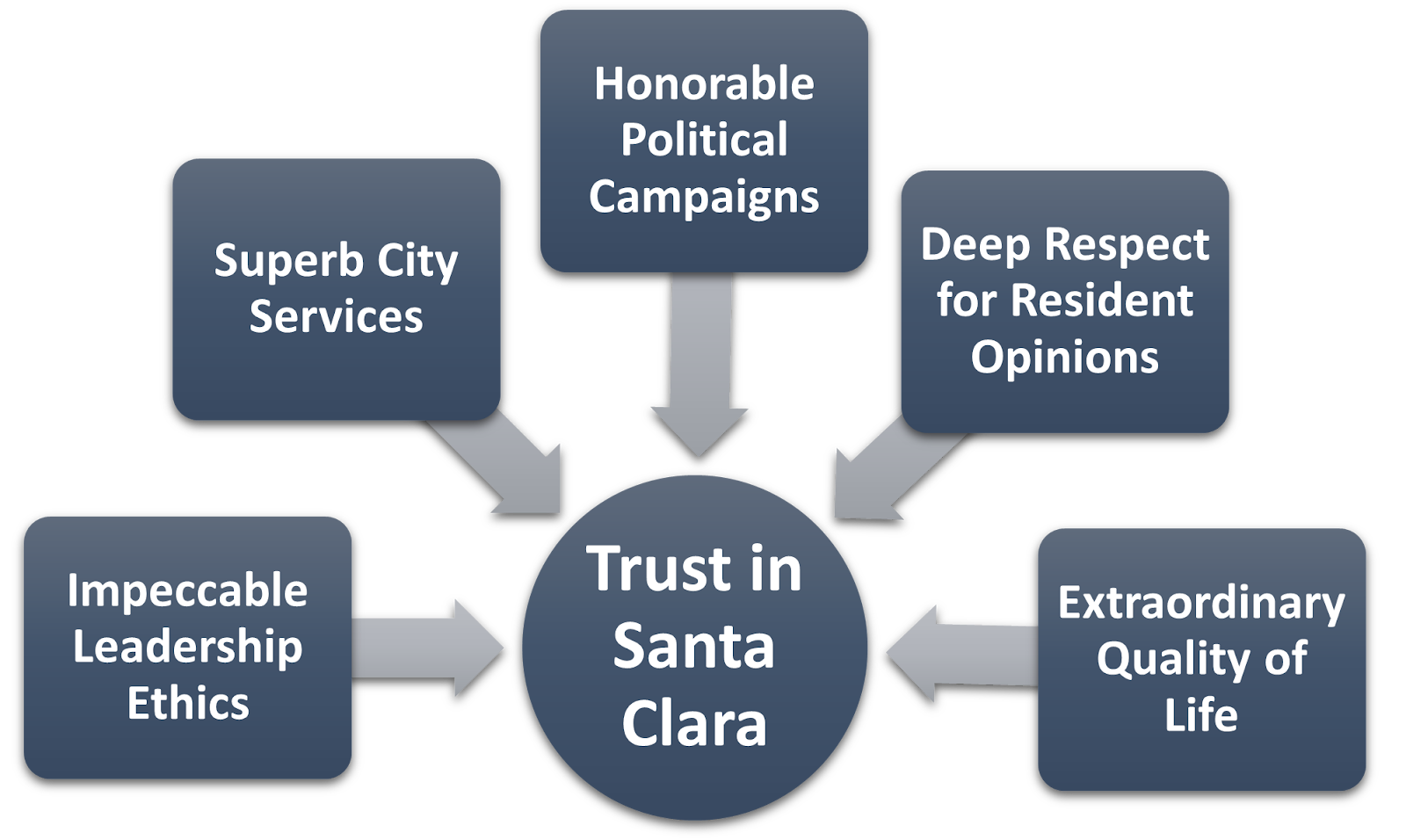
The chart above presents some of the most useful findings: what correlates with public trust. What other measures rise or fall along with public trust.
The City discovered that five resident perceptions are correlated with public trust. Public trust rose as residents rated:
Leadership ethics: Trust rose or fell as residents rated leadership ethics from "Poor" to "Excellent." The City's goal was impeccable leadership ethics.
City Services: Trust rose or fell as residents rated City services from "poor" to "excellent." The City's goal was superb city services.
Political Campaigns: Trust rose or fell as residents ratings of campaigns
Council Treatment of Residents:
Quality of Life:
Take the Survey: The City Today
What's your assessment today?
Help us establish our 2025 baseline by taking this 5-minute survey. We'll share preliminary results in early February so you can see what your neighbors think. We won't be able to generalize our findings to the whole city, because we are unable to pull a random sample.
Until the city resumes asking residents about ethics, governance, and public trust, these results will have to do.
What Is Public Trust?
Public trust is necessary for a city government to function at all. Government gets its authority to govern only with the consent of the people. People do not give their consent to people they don't trust. So, public trust is the people's confident reliance that their government works hard at all times—in public and in private—only for the best interests of all. It never puts private, personal, or special interests ahead of the government's sworn duty to work only for the people.
How Santa Clara Lost Trust
Three Santa Clara County Grand Jury Reports (2022, 2024) documented the ethics failures that led to the loss of public trust:
Political capture of five of seven City Council (and Stadium Authority) seats through millions in legal independent expenditures by the 49er PACs.
A council majority regularly voting for 49ers interests over the public interest, with no resolution to the apparent conflicts of interest.
Broken relationships between council members preventing effective governance.
The 49ers outmaneuvering the city and its legal consultants in the original stadium contracts and in settlements the council majority signed in 2022 and 2024.
Will the City Act Ethically?
Three city projects underway right now could restore public trust—or damage it further and for decades to come.
Charter Review | Ethics Code Review | Ethics Commission
Done right, these projects could commit the city and Stadium Authority to ethical governance, create a sustainable public trust program, modernize the award-winning 2001 Code of Ethics & Values, and establish an independent ethics commission with real authority and resources for advice, training, investigations, advocacy, and oversight.
That's the promise. To reach it, the city needs to change direction on each of these projects now. Surprisingly, and perhaps inadvertently, staff decisions have restricted these projects or set them up to fail.
This is a very big deal. Read the full story here.
Thomas Jefferson once wrote,
"Whenever the people are well informed, they can be trusted with their own government; that whenever things get so far wrong as to attract their notice, they may be relied on to set them to rights."
When "going in the right direction" ratings plunge from 91% to 40%, the people have noticed. Jefferson believed—and so does Public Ethics Now: informed stakeholders can, and will, correct course.
Real political leadership offers to take people to where, in their best selves, they really want to go.--Jim Wallis, Georgetown U.
Speak Up for Public Trust
With three foundational projects underway, now is the time for informed Santa Clara stakeholders to raise their voices to insist on sustainable—and real—ethics reform.
PEN believes such reform must include:
A Charter-anchored ethics program
Building upon and expanding the 2001 ethics code and implementation program for city officials, the Stadium Authority, and staff
A truly independent ethics commission to provide skills training and guidance, hold leaders accountable when enforcement is necessary, and create opportunities for officials to demonstrate they have fulfilled their duty to (a) make the people of Santa Clara their top priority and (2) to serve only the best interests of the people.
Want to take action now? Check out the Take Action page for a sample letter you could send to the Mayor and Council. You will also find talking points if you want to speak during public comment. Please do this by February 4, if possible.